
Written by Gregory S. Young, Senior Partner at Gregory S. Young Co., LPA
Bar admissions: Ohio State Bar; U.S. District Court, S.D. Ohio. Practice focus: Personal Injury, Car Accidents, Wrongful Death.
GSY has represented injured Ohioans since 1958. Free consultation: 513-721-1077
Diane was rear-ended on I-275 near Cincinnati on a Tuesday afternoon. The impact wasn't catastrophic. her neck hurt, she was shaken, but she drove home. She didn't call police. She exchanged phone numbers with the other driver, who promised to work things out directly. Two days later, he stopped answering. By the time Diane sought medical attention for the worsening neck and shoulder pain, ten days had passed. The other driver's insurer denied her claim, arguing she couldn't prove the injury was from the accident. No police report. No photos. No witness names. A $38,000 orthopedic injury that should have been someone else's problem became hers.
Knowing what to do after a car accident in Ohio before you're in that situation is one of the most valuable things you can read today.
Why the First 15 Minutes Matter More Than the Next 15 Days
Ohio roads are unforgiving. According to NHTSA, an estimated 17,140 people died in motor vehicle crashes nationally in just the first half of 2025. In April 2026, a reckless driver on State Route 48 in Warren County crossed the median into oncoming traffic, injuring three people and closing the road for hours. Accidents happen fast, injuries evolve slowly, and the evidence that determines your compensation disappears almost immediately.
What you do at the scene sets the foundation for everything that follows.
Step 1: Stop and Secure the Scene
Under Ohio Revised Code § 4549.02, you are legally required to stop your vehicle after any crash involving injury, death, or property damage. Leaving the scene is a criminal offense. Move your vehicle out of active traffic if it is safe to do so, turn on hazard lights, and set out warning triangles or flares if you have them.
Do not move anyone who appears to have a head, neck, or spinal injury unless they are in immediate danger. Moving an injured person incorrectly can worsen a spinal cord injury.
Step 2: Call 911. Even If the Crash Seems Minor
Call 911 any time someone is injured, a car cannot be driven, or there is significant property damage. Even in minor crashes, having an official police report on record is critical.
Ohio insurance adjusters we've negotiated against for 65+ years will use every gap in documentation to minimize your claim. A police report establishes the location, time, parties involved, and often an initial fault determination. Without it, your word against the other driver's word is all you have.
When officers arrive, give a factual, truthful account. Do not speculate about fault. If you're uncertain about something, say so.
What the Ohio Crash Report (OH-1) Actually Tells an Insurer
The OH-1 is four pages. Most people read one.
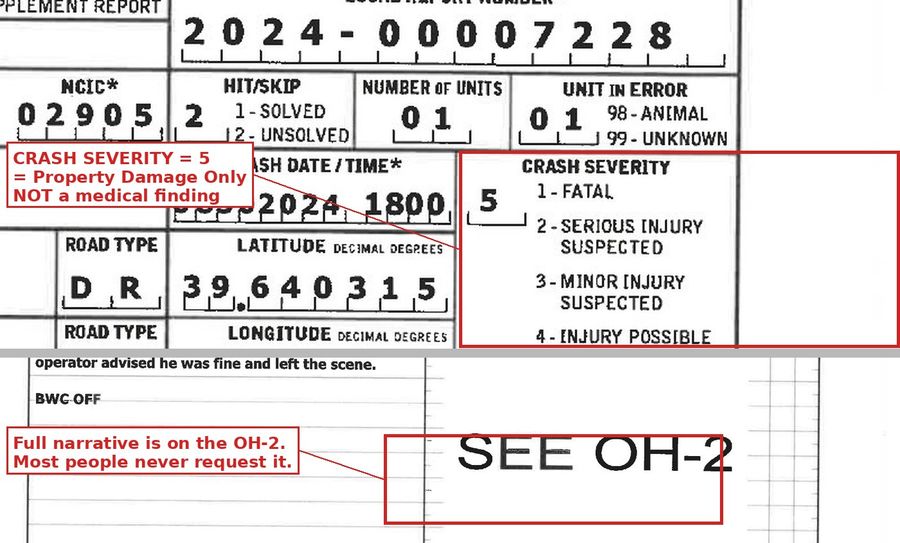
After 40 years of car accident cases, this is the first document I request on every new file. The other driver's insurer requests it too, usually before you have even made a formal claim.
The summary page often ends with SEE OH-2. That means the officer's full narrative and crash diagram are on separate continuation pages. The OH-2 is where the real story lives. I have seen clients never know it existed.
Three fields shape almost every claim.
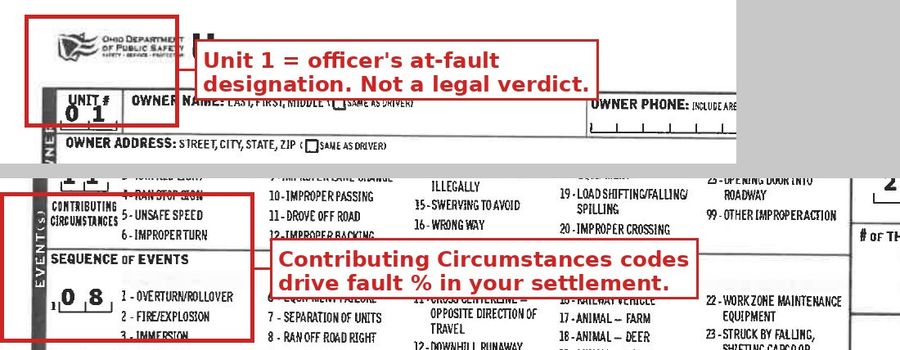
Contributing Circumstances codes. The officer picks from a numbered list: Code 2 is Failure to Yield, Code 8 is Following Too Close, Code 11 is Drove Off Road. Whatever code sits next to your name is what the opposing insurer cites to argue shared fault. A 20 percent fault finding cuts a $100,000 recovery by $20,000. Those codes matter more than most people realize.
Unit 1. That is the driver the officer believes caused the crash. Adjusters treat it like a verdict. It is not. It is one officer's opinion, written under time pressure at a roadside. I have challenged Unit 1 designations with photos, witnesses, and accident reconstruction. It can be overturned.
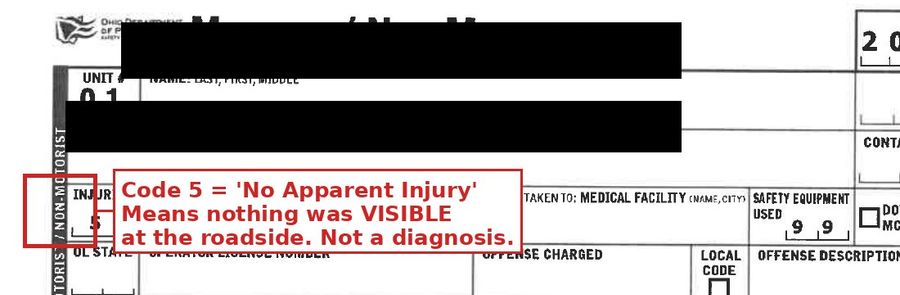
Injury code 5: No Apparent Injury. This does not mean you were not hurt. It means no injury was visible to the officer at the scene. Herniated discs and concussions do not show up in a flashlight check. Seek medical care the same day. If you wait four days and your report says code 5, the adjuster will use that gap against you.
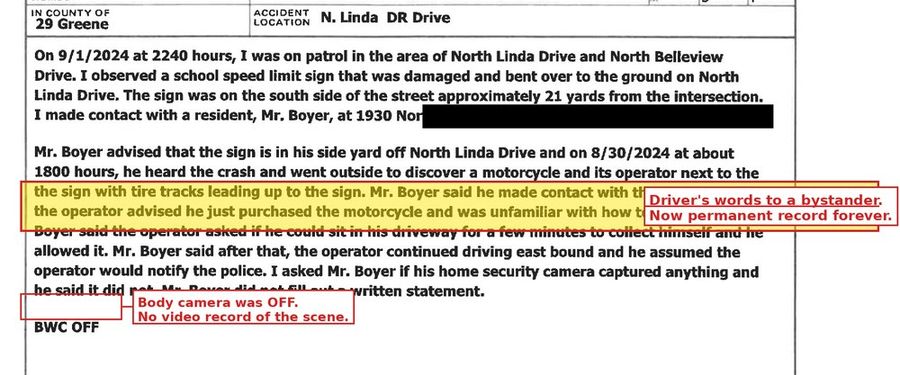
One more thing. Whatever you say to a bystander at the scene can end up verbatim in the officer's narrative. In a real Greene County report, a driver told a neighbor he had just purchased the vehicle and did not know how to operate it. The officer wrote it down word for word. That statement followed the claim from the first phone call forward.
To get your report: go to ohtrafficdata.dps.ohio.gov. It can take up to six weeks to post. If you need it faster, call the investigating agency directly. Ohio State Highway Patrol charges $4. Most local departments are free.
Step 3: Document Everything Before You Leave the Scene
While waiting for police, use your phone. Documentation gathered in the first 15 minutes is irreplaceable:
- Photos of all vehicles — all four sides, damage close-up, license plates
- Photos of the scene — road conditions, traffic signs, skid marks, debris field
- Photos of your injuries — bruising, lacerations, airbag burns, seat belt marks (photograph again at home 24-48 hours later)
- Video walk-through of the scene while narrating what you observe
- Names, phone numbers, and insurance info from all drivers
- Names and contact info of witnesses — bystanders leave fast; get their information immediately
Step 4: Exchange Information — Exactly What Ohio Law Requires
Per ORC § 4549.02, all drivers involved must exchange:
- Full name and address
- Vehicle registration number
- Driver's license number
- Insurance company name and policy number
If the other driver refuses or cannot provide insurance information, note this for police. Ohio requires minimum liability insurance ($25,000/$50,000/$25,000 under ORC § 4509.51), but uninsured driving remains common. Your own uninsured motorist (UM) coverage may be your primary source of compensation in that situation.
Step 5: Seek Medical Attention the Same Day
Even if you feel mostly okay, go to an emergency room, urgent care, or your primary care doctor the same day. Many of the most costly injuries from car accidents — herniated discs, traumatic brain injuries, soft tissue damage — do not produce intense pain immediately. Adrenaline masks injury. Inflammation peaks 24 to 72 hours after impact.
Why this matters for your claim: A gap in treatment is one of the first things an insurance adjuster will use against you. If you were really hurt, why did you wait four days? is a standard tactic. Same-day medical documentation closes that door.
Keep every bill, every discharge instruction, every prescription, and every follow-up appointment record. Ask your provider to document all symptoms you report, even those that seem minor at the time.
Step 6: Notify Your Insurance Company — Carefully
Your policy requires prompt notification of any accident. Call your insurer within 24 hours to report the crash, but keep it factual and brief. Do not give a recorded statement to the other driver's insurance company without first speaking with an attorney. You are not required to.
The other driver's adjuster may call you within hours of the accident, seeming sympathetic and eager to resolve things quickly. Their job is to close your claim fast, before you understand the full extent of your injuries. Anything you say in a recorded statement can be used to reduce or deny your claim.
Step 7: Understand Ohio's Fault Rules Before You Talk Numbers
Ohio uses a modified comparative negligence system. You can recover compensation as long as you are less than 51% at fault. Your recovery is reduced by your percentage of fault. If a jury finds you 20% at fault and your damages are $100,000, you recover $80,000.
This rule matters for a reason many people miss: insurers routinely argue shared fault to reduce payouts. If you apologized at the scene, said I didn't see you, or gave a recorded statement describing your speed or lane position, they may use that to assign you partial responsibility. An attorney reviews the facts before you make any admissions.
Step 8: Know Your Deadline — Two Years, No Exceptions
Ohio's statute of limitations for car accident injury claims is two years from the date of the accident (ORC § 2305.10). Miss this deadline and you lose your right to sue permanently, regardless of how serious your injuries are.
Two years sounds like a long time. It isn't. Thorough investigation, gathering medical records, identifying all responsible parties, and negotiating with insurers takes months. Filing a lawsuit near the deadline is far worse than filing with time to prepare.
What Your Ohio Car Accident Claim Is Actually Worth
The question everyone has but few ask out loud: what is my claim worth?
Ohio law allows injured drivers to recover medical expenses (all treatment, PT, surgery, medication, and estimated future care), lost wages including future earning capacity if permanently impaired, property damage at fair market value, pain and suffering, loss of enjoyment, and wrongful death damages including funeral costs and lost support.
As of 2026, Ohio caps non-economic damages at the greater of 3x economic damages or $350,000 per plaintiff (up to $500,000 per incident with multiple injured parties). Proposed House Bill 447 would raise that cap to $415,000. Severe injury cases may benefit from constitutional challenges following the Ohio Supreme Court's Brandt v. Pompa (2022) decision.
In car accident cases we've published on our results page, GSY's recoveries have ranged from $50,000 to $650,000, including $525,000 for a rear-end collision and $650,000 for a failure-to-yield case. These are select published outcomes; your case value depends on injury severity, liability, and insurance coverage.
Past results do not guarantee similar outcomes.
Quick-Reference Timeline
- At the scene: Stop, call 911, document everything, exchange info
- Same day: Seek medical attention; notify your own insurer briefly
- Within 48 hours: Follow up with doctor; photograph injuries again; do not give recorded statement to other driver's insurer
- Within 1 week: Preserve all receipts, bills, records; consult a personal injury attorney
- Within 30 days: Attorney sends spoliation letter to preserve vehicle data, surveillance footage, dashcam footage
- Within 6 months: Complete treatment or reach maximum medical improvement (MMI) before settling
- Within 2 years: File lawsuit if settlement is not reached (ORC § 2305.10 deadline)
If You Were in a Crash in Cincinnati or Anywhere in Ohio
Gregory S. Young Co., LPA has been representing Ohio car accident victims since 1958 — longer than any other personal injury firm in Cincinnati. We've handled car accident cases across Hamilton, Warren, Butler, Clermont, and Montgomery counties, as well as in Kentucky for crashes near the border.
If you were injured in an accident, the consultation is free. We take no fee unless we win. Call 513-721-1077, available 24/7, or contact us online.
This article is for informational purposes only and does not constitute legal advice. Past results do not guarantee similar outcomes. Contact GSY for a free consultation about your specific situation.
Were You Hurt in a Car Accidents Incident?
You may be entitled to compensation. Our attorneys offer free consultations — and you pay nothing unless we win your case.
- No fee unless we win
- Free consultations 24/7
- Serving Ohio & Kentucky since 1958
